
The City of Mantua Refuge
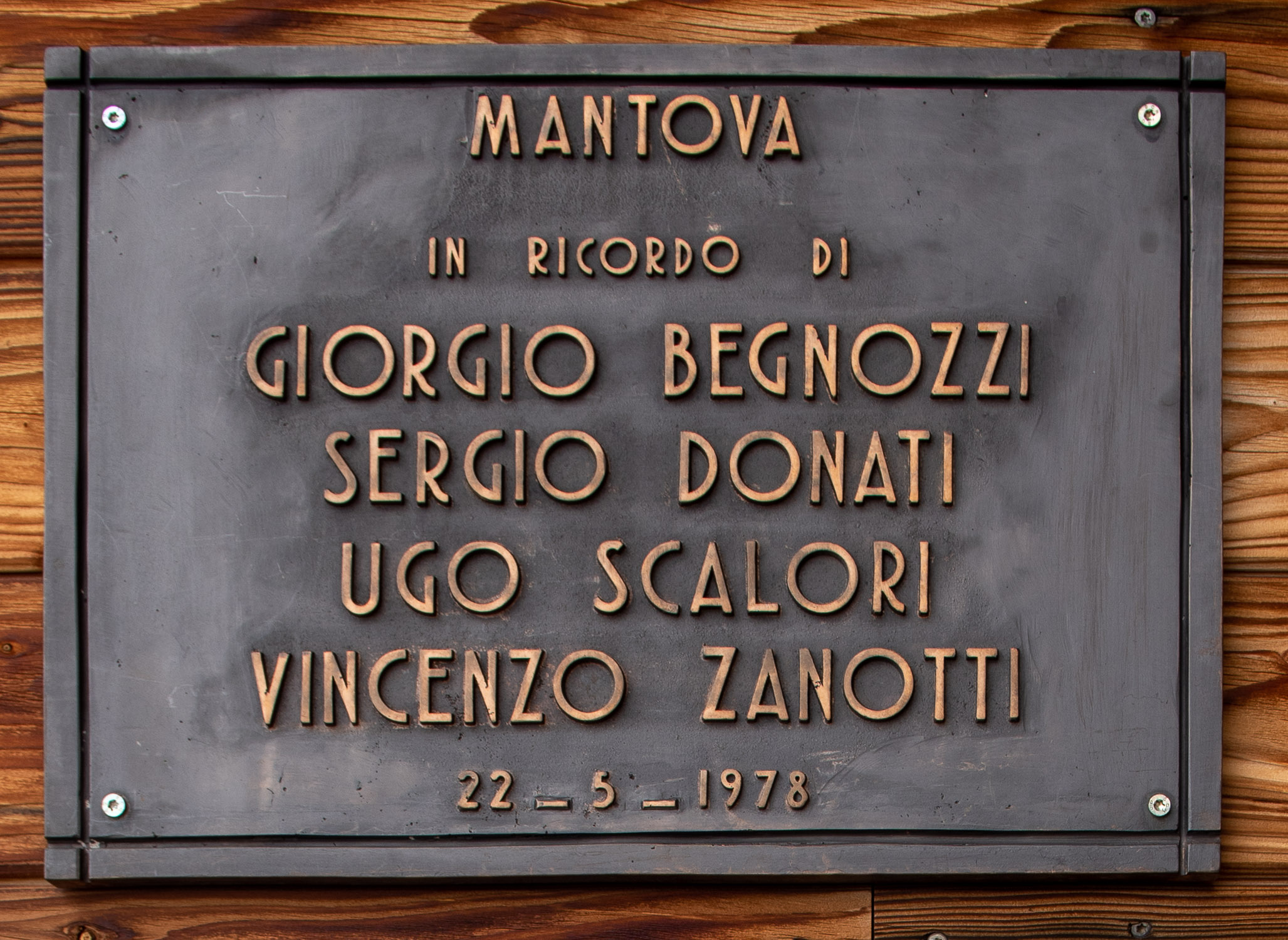
The plaque in memory of the victims
In 1978, one of the most tragic events in the history of mountaineering on Monte Rosa occurred. On May 22, family members lost contact with four climbers from Mantua who had left Capanna Gnifetti to cross the “Naso del Lyskamm”. The father of one of them contacts Arturo Squinobal, a guide from Gressoney and member of the mountain rescue service, who immediately sets the rescue operation in motion: for four days, mountain guides and rescuers from Gressoney, Champoluc, Alagna, and Cogne, with the help of helicopters, combed a huge area of the glacier in terrible weather conditions, risking their lives several times. A deployment of men and means unfortunately in vain: on the 26th morning, at 9:30 a.m., the first body was found buried under two meters of snow, thanks to the fact that some of the victims were using a tool similar to Artva, and avalanche dogs. The other three will be found not far away.

The plaque commemorating the inauguration, 2/9/1984
The families of the victims, grateful for the efforts expended during the rescue operation, collected a considerable amount of money, which they donated to the Gressoney guides. The guides decided to use this sum to build a shelter near the sites of the tragedy. The initial sum was supplemented by contributions from the local branch of the Italian Alpine Club (CAI), the Municipality of Mantua, several banks, and the Aosta Valley. The refuge was inaugurated on September 2, 1984, under the name “Rifugio Città di Mantova” (Mantua City Refuge).
The story is recounted in detail in the book “Due montanari” (Two Mountain Men) by Maria Teresa Cometto, dedicated to the lives and exploits of Arturo and Oreste Squinobal (who participated firsthand in the rescue operations).
On this page I have reproduced some articles from thearchives of La Stampa newspaper that document:
- the days of tragedy, May 22-27, 1978
- the opening of the shelter, which took place in September 1984.
The 1978 incident
Eight articles, from May 22 (the day the alarm was raised) to May 27, 1978 (the day after the bodies were discovered)
Four missing on Monte Rosa
 (open the article)
AOSTA – Four mountaineers from Mantova are missing mei Rosa massif: they have been missing since Sunday. They are Sergio Donati, 54, Ugo Scolari(actually Scalori, ed.), 39, Giorgio D’Agliossi(actually Begnozzi, ed.), 40, all residents of Mantua, and Vincenzo Zanotti, 33, a resident of the province. Rescue teams set out to search for them, assisted by a helicopter.
(Evening Press, May 23, 1978)
The searches are always hampered by bad weather.
Missing on Rosa 4 mountaineers
Disappeared while returning from the Sella refuge to the Gnifetti hut
FROM OUR CORRESPONDENT
AOSTA — Four mountaineers from Mantua have been missing since Sunday on the Monte Rosa massif, at an altitude of over three thousand meters. The hikers, Sergio Donati, 54, Giorgio Begnozzi, 41, Ugo Scalori, 39, and Vincenzo Zanotti, 33, had set out from the Gnifetti hut (m. 3647) in the upper Gressoney Valley to make the ski-mountaineering traverse to the Quintino Sella hut (m. 3585) in the upper Ayas Valley. The trip is among the “classics” of spring skiing: this year, however, due to heavy snowfall, it involves particularly arduous environmental difficulties. Upon reaching the Sella hut, the four mountaineers had decided to return by retracing the same route. Rescue efforts were organized Monday afternoon, when news was received that the hikers had not returned. Guides and valley people came up from Gressoney and Champoluc to conduct patrols in the area. A notation left by the four in which they explain their decision to return due to adverse weather conditions was found at the Sella hut. A military helicopter is also participating in the operations, but its deployment was limited by poor visibility. The high mountain areas are shrouded in a thick cloud cover, and while waiting for a clearing, the search continues with patrols by guides and valley people. Operations are being coordinated from the Gnifetti refuge, where two guides from Alagna also went up last night, carrying special radio equipment capable of picking up signals emitted by a transmitter. In fact, it appears that two of the four missing climbers have these particular devices on them, which have proven to be very efficient especially for tracking people buried by avalanches. Among the most pessimistic hypotheses so far made by those closely following the progress of the search, it is in fact not ruled out that the four may have been swept away by an avalanche. However, searches conducted yesterday on a large section of the route, presumably traveled by the climbers, yielded no results. “No tracks were even found,” pointed out Fritz Barrell, the guide coordinating the operations, “except for the written indication left on their return to the shelter. Family members of the four climbers are in Gressoney anxiously waiting. The search for the climbers was suspended yesterday in the early afternoon due to bad weather; in fact, it is snowing heavily in the area. A mountain guide from the rescue teams was caught in a small avalanche near the “Naso del Lyskamm” and suffered minor bruises.
Giorgio Giannone
(La Stampa, May 24, 1978)
News of the four Mountaineers from Mantova has been missing since Sunday
A note, the only trace of the missing on Rosa
 (open the article)
AOSTA — The search resumed this morning for the four climbers from Mantua who have been missing since Sunday in the Monte Rosa massif during a ski mountaineering trip. The four: Ugo Scalori, 39, a lawyer, married and father of two daughters; Sergio Donati, 54, a chemist, a former Montedison executive* Giorgio Begnozzi, a merchant, 41, vice president of the Cai di Mantova, married and father of a 12-year-old boy; and Vincenzo Zanotti, 33, owner of a large farm, had left Sunday from the Gnifetti hut in the Upper Gressoney Valley and reached the Quintino Sella hut in the adjacent Ayas Valley during the day. It is certain that the small group had brought the hike to an end: a note from them was found Monday afternoon at the “Sella” by guides who had left Champoluc and Oressoney as soon as the alarm had been sounded that the climbers had not returned. In the note, the four explained that they had decided to return to Gressoney via the same route due to bad weather.
g. g
(Stampa Sera, May 24, 1978)
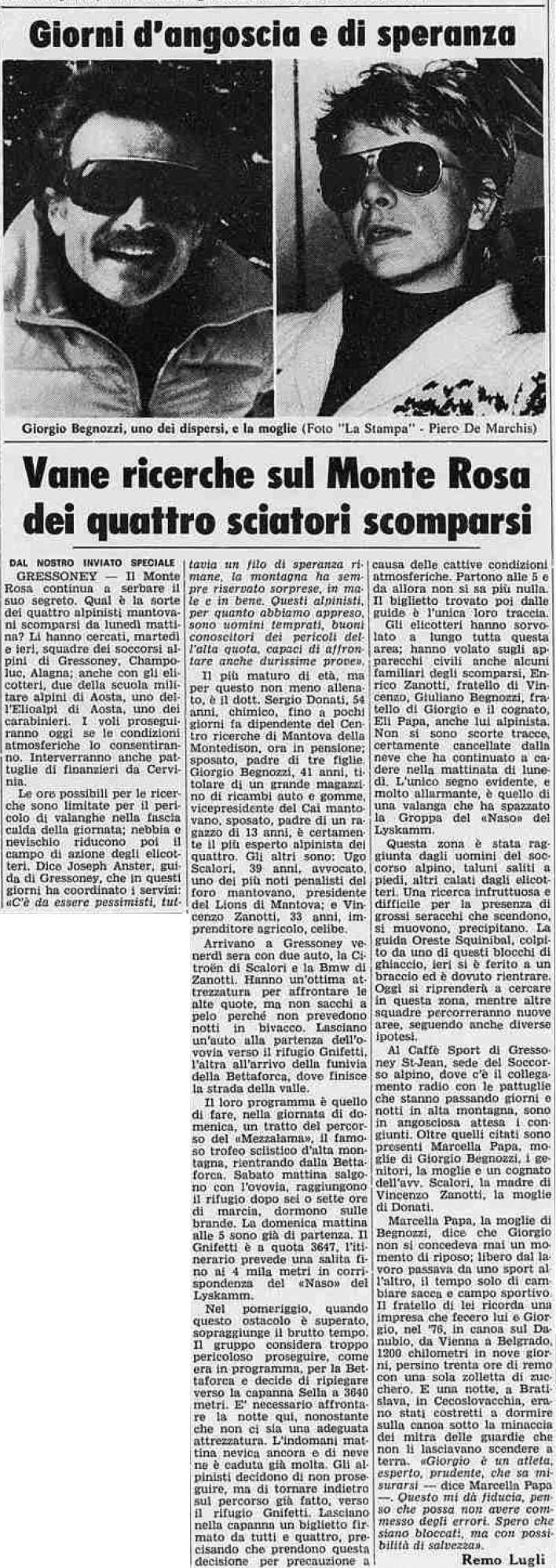
Vane ricerche sul Monte Rosa dei quattro sciatori scomparsi
 (open the article)
FROM OUR SPECIAL CORRESPONDENT
GRESSONEY — Monte Rosa continues to keep its secrets. What is the fate of the four Mountaineers from Mantova who have been missing since Monday morning? Alpine rescue teams from Gressoney, Champoluc, and Alagna searched for them on Tuesday and yesterday; also with helicopters, two from the Alpine military school in Aosta, one from the Elioalpi in Aosta, and one from the Carabinieri. Flights will continue today if weather conditions permit. Financial patrols from Cervinia will also intervene. Possible search hours are limited due to avalanche danger in the warm part of the day; fog and sleet then reduce the range of helicopters. Says Joseph Anster, a guide from Gressoney, who has been coordinating the services these days, “There is reason to be pessimistic, however a thread of hope remains, the mountains have always reserved surprises, for bad and for good. These mountaineers, as far as we have learned, are hardened men, good connoisseurs of the dangers of high altitude, capable of facing even very hard trials.” The most mature in age, but no less trained for that, is Dr. Sergio Donati, 54, a chemist, until a few days ago an employee of Montedison’s Mantua Research Center, now retired; married, father of three daughters. Giorgio Begnozzi, 41, owner of a large auto parts and tire store, vice president of the Mantua CAI, married, father of a 13-year-old boy, is certainly the most experienced mountaineer of the four. The others are: Ugo Scalori, 39, a lawyer, one of the best-known criminal lawyers in the Mantua Bar, and president of the Mantua Lions; and Vincenzo Zanotti, 33, an agricultural entrepreneur, single. They arrived in Gressoney Friday night in two cars, Scalori’s Citroen and Zanotti’s Bmw. They have good equipment to cope with the high altitudes, but no sleeping bags because they do not plan bivouac nights. They leave one car at the start of the cable car to the Gnifetti refuge and the other at the arrival point of the Bettaforca cable car, where the valley road ends. Their plan is to complete a section of the “Mezzalama” route, the famous high-altitude skiing trophy, on Sunday, returning from Bettaforca. Saturday morning they go up by cable car, reach the hut after six or seven hours of walking, sleep on cots. On Sunday morning at 5 a.m. they are already leaving. The Gnifetti is at an altitude of 3,647 meters, and the route involves a climb to 4,000 meters at the “Nose” of the Lyskamm. In the afternoon, once this obstacle has been overcome, bad weather sets in. The group considers it too dangerous to continue as planned towards Bettaforca and decides to fall back to the Sella hut at 3,640 meters. It is necessary to face the night here, despite the fact that there is no proper equipment. The next morning it is still snowing and a lot of snow has already fallen. The mountaineers decide not to continue, but to turn back on the route already taken, toward the Gnifetti refuge. They leave a note signed by all four of them in the hut, specifying that they make this decision as a precaution due to bad weather conditions. They left at 5 o’clock and have not been heard from since. The note later found by the guides is their only lead. Helicopters flew over this entire area for a long time; some family members of the disappeared, Enrico Zanotti, Vincenzo’s brother, Giuliano Begnozzi, Giorgio’s brother, and his brother-in-law, Eli Papa, also a mountaineer, also flew on the civilian aircraft. No tracks were stocked, certainly obliterated by the snow that continued to fall on Monday morning. The only obvious, and very alarming, sign is that of an avalanche that swept across the “Naso” of Lyskamm. This area was reached by mountain rescue men, some ascended on foot, others lowered by helicopters. A fruitless and difficult search due to the presence of large seracs that descend, move, plummet. Guide Oreste Squinibal, struck by one of these ice blocks, injured his arm yesterday and had to return. Searching will resume in this area today, while other teams will cover new areas, also following different hypotheses. At the Caffè Sport in Gressoney St-Jean, headquarters of the Alpine Rescue Service, where there is radio contact with the patrols spending days and nights in the high mountains, relatives wait anxiously. In addition to those mentioned above, Marcella Papa, wife of Giorgio Begnozzi, and the parents, wife and a brother-in-law of the lawyer are present. Scalori, Vincenzo Zanotti’s mother, Donati’s wife. Marcella Papa, Begnozzi’s wife, says that Giorgio never allowed himself a moment’s rest; when he wasn’t working, he went from one sport to another, with just enough time to change his bag and sports field. Her brother recalls a feat he and Giorgio did in ’76, canoeing on the Danube, from Vienna to Belgrade, 1,200 kilometers in nine days, even thirty hours of paddling with a single sugar cube. And one night, in Bratislava, Czechoslovakia, they had been forced to sleep on the canoe under the threat of machine guns from guards who would not let them go ashore. “Giorgio is an athlete, experienced, cautious, who knows how to measure himself,” says Marcella Papa. “This gives me confidence, I think he may not have made mistakes. I hope they are stuck, but with a chance of salvation.”
Remo Lugli
(La Stampa, May 25, 1978)
Rescuers continue snowfall search
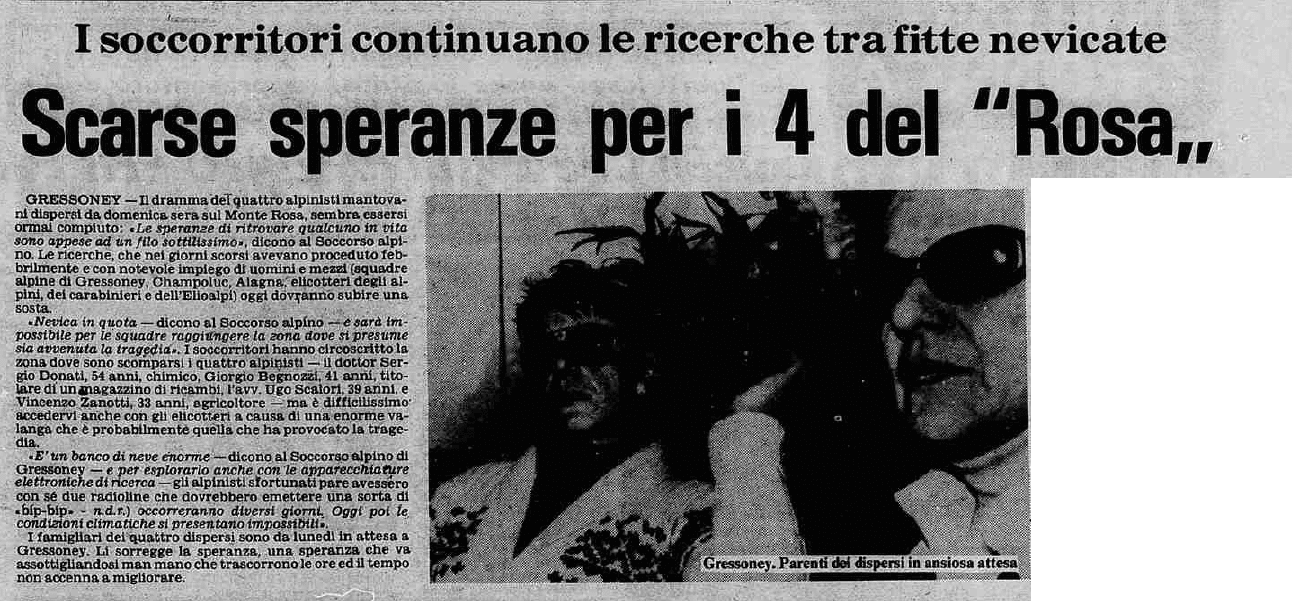
Little hope for the 4 of the “Pink
 (open the article)
GRESSONEY — The drama surrounding the four mountaineers from Mantua who have been missing since Sunday evening on Monte Rosa seems to have come to an end: “The chances of finding anyone alive are hanging by a very thin thread,” say the mountain rescue services. The search, which in recent days had proceeded feverishly and with considerable deployment of men and means (alpine teams from Gressoney, Champoluc, Alagna, helicopters of the alpine, carabinieri and Elioalpi) today will have to come to a halt. “It is snowing at high altitude,” they tell Mountain Rescue, “and it will be impossible for teams to reach the sona where the tragedy is presumed to have occurred.” Rescuers have circumscribed the area where the four mountaineers-Dr. Sergio Donati, 54, a chemist; Giorgio Begnozzi, 41, a parts warehouse owner; Ugo Scalori, 39, a lawyer; and Vincenzo Zanotti, 33, a farmer-but it is extremely difficult to access even with helicopters because of a huge avalanche that is probably what caused the tragedy. It’s a huge snowbank-they say at Gressoney Mountain Rescue-and to explore it even with electronic search equipment-the unfortunate climbers apparently had two small radios with them that are supposed to emit a kind of “beep-beep”-note) will take several days Today then the, weather conditions are looking impossible.” Family members of the four missing have been waiting in Gressoney since Monday. They are sustained by hope, a hope that is fading as the hours pass and the weather shows no sign of improving.
(Stampa Sera, May 25, 1978)
Nervous waiting for family members in Gressoney hotel.
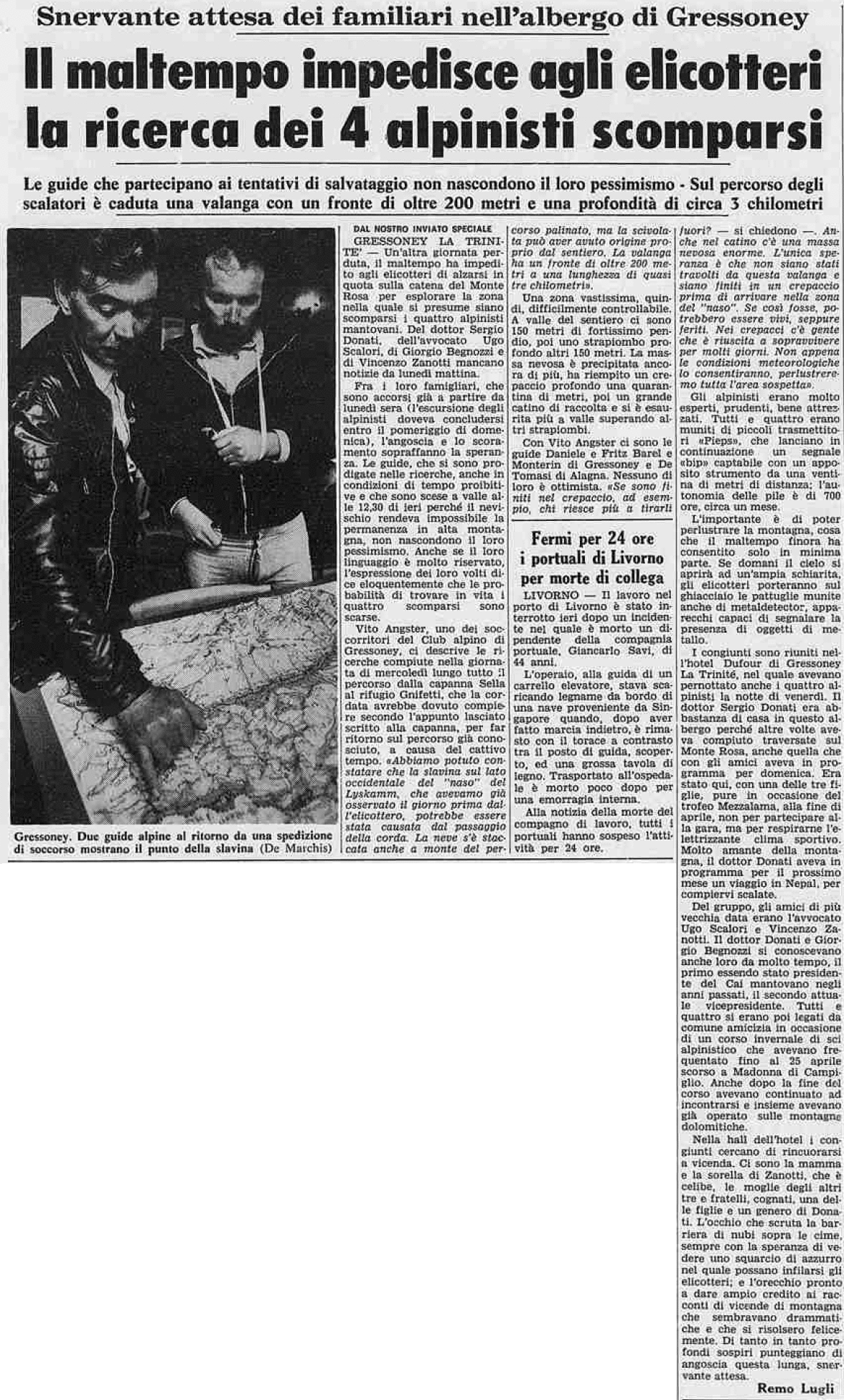
Bad weather prevents helicopters from searching for four missing climbers
Guides participating in rescue efforts make no secret of their pessimism climbers an avalanche has fallen with a front of more than 200 meters and a depth of about 3 kilometers
 (open the article)
FROM OUR SPECIAL CORRESPONDENT
GRESSONEY LA TRINITE’ — Another day lost, as bad weather prevented helicopters from flying over the Monte Rosa range to explore the area where the four climbers from Mantua are believed to have disappeared. Dr. Sergio Donati, lawyer Ugo Scalori, Giorgio Begnozzi and Vincenzo Zanotti have been missing since Monday morning. Among their family members, who rushed in as early as Monday evening (the mountaineers’ hike was to be completed by Sunday afternoon), anguish and discouragement overwhelmed hope. The guides, who worked tirelessly on the search, even in prohibitive weather conditions, and who descended to the valley at 12:30 yesterday because the sleet made it impossible to remain at high altitude, do not hide their pessimism. Although their language is very reserved, the expression on their faces eloquently says that the chances of finding the four missing men alive are slim. Vito Angster, one of the rescuers from the Gressoney Alpine Club, describes the search carried out on Wednesday along the entire route from the Sella hut to the Gnifetti refuge, which the climbing party should have taken according to the note left at the hut, in order to return along the familiar route due to bad weather. “We were able to see that the avalanche on the western side of the Lyskamm’s ‘nose’, which we had already observed the day before from the helicopter, may have been caused by the passage of the rope. The snow also broke away upstream of the marked route, but the slide may have originated from the trail itself. The avalanche has a front of over 200 meters and a length of almost three kilometers.” A very large area, therefore, difficult to control. Downstream from the trail there is a 150-meter steep slope, followed by a 150-meter deep precipice. The snow mass plummeted even further, filled a crevasse some 40 meters deep, then a large catch basin, and ran out further downstream past more overhangs. With Vito Angster are guides Daniele and Fritz Barel and Monterin of Gressoney and De Tomasi of Alagna. None of them are optimistic. “If they got into the crevasse, for example, who can get them out anymore? – they wonder -. Even in the bowl there is a huge snow mass. The only hope is that they were not swept away by this avalanche and ended up in a crevasse before reaching the “nose” area. If so, they may be alive, albeit injured. There are people in the crevasses who managed to survive for many days. As soon as weather conditions allow, we will search the whole suspected area.” The climbers were very experienced, cautious, well-equipped. All four were equipped with small “Pieps” transmitters, which continuously launch a “beep” signal that can be picked up with a special instrument from about 20 meters away; the battery life is 700 hours, about one month. The important thing is to be able to explore the mountain, which bad weather has only allowed to a limited extent so far. If the skies clear tomorrow, helicopters will take patrols to the glacier also equipped with metal detectors, devices capable of signaling the presence of metal objects. The relatives are gathered at the Dufour Hotel in Gressoney La Trinité, where the four mountaineers had also stayed on Friday night. Dr. Sergio Donati was quite familiar with this hotel because he had made other crossings on Monte Rosa, including the one he had planned with his friends for Sunday. He had been here, with one of his three daughters, as well on the occasion of the Mezzalama Trophy at the end of April, not to participate in the race, but to breathe in its electrifying sporting atmosphere. A great lover of the mountains, Dr. Donati was planning to travel to Nepal next month to perform climbs there. Of the group, the oldest friends were lawyer Ugo Scalori and Vincenzo Zanotti. Dr. Donati and Giorgio Begnozzi had also known each other for a long time, the former having been president of the Mantua CAI in previous years, the latter currently serving as vice president. All four had then bonded through common friendship during a winter ski mountaineering course they had attended until April 25 in Madonna di Campiglio. Even after the course was over, they had continued to meet, and together they had already operated in the Dolomite mountains. In the hotel lobby, the relatives try to hearten each other. There are Zanotti’s mother and sister, who is single, the wives of the other three and brothers, brothers-in-law, one of Donati’s daughters and a son-in-law. The eye scanning the cloud barrier above the peaks, always with the hope of seeing a glimpse of blue into which helicopters might slip; and the ear ready to give ample credence to tales of mountain happenings that seemed dramatic and resolved happily. From time to time deep sighs punctuate this long, nerve-wracking wait with anguish.
Remo Lugli
(La Stampa, May 26, 1978)
On Rosa: they had been buried under a huge avalanche
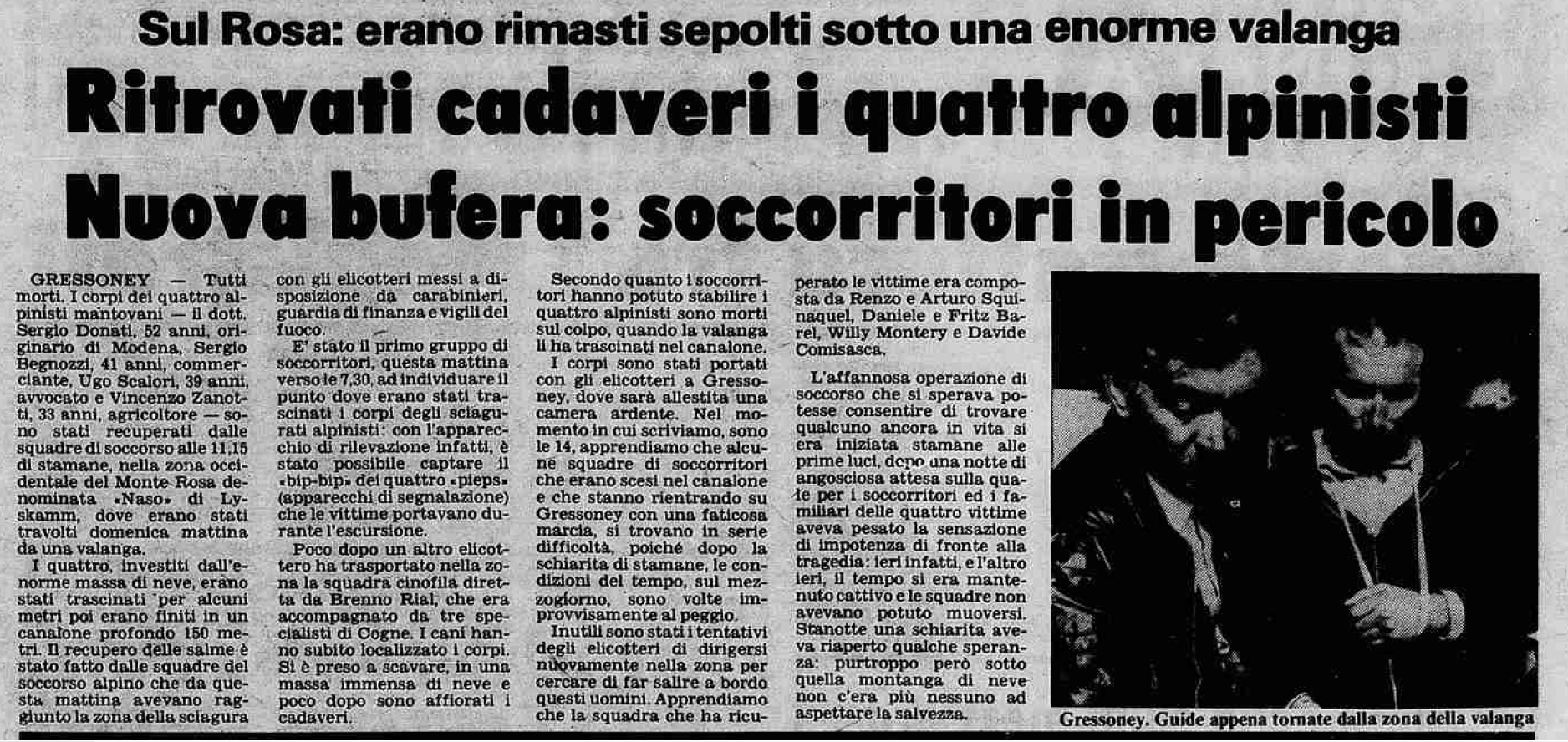
Four mountaineers found dead
New storm : rescuers in danger
 (open the article)
GRESSONEY – All dead. The bodies of the four climbers from Mantua — Dr. Sergio Donati, 52, originally from Modena, Sergio Begnozzi, 41, merchant, Ugo Scalori, 39, lawyer, and Vincenzo Zanotti, 33, farmer — were recovered by rescue teams at 11:15 this morning in the western part of Monte Rosa known as the “Naso” of Lyskamm, where they had been swept away by an avalanche on Sunday morning. The four, hit by the huge mass of snow, had been dragged for a few meters then ended up in a 150-meter-deep gully.The recovery of the bodies was done by mountain rescue teams who had been reaching the area of the disaster since this morning with helicopters provided by the Carabinieri, Guardia di Finanza and firefighters. It was the first group of rescuers, this morning at around 7:30 a.m., who located the spot where the bodies of the ill-fated mountaineers had been dragged: in fact, with the detection equipment, it was possible to pick up the “beep-beep” of the four “Pieps” (signaling devices) that the victims were carrying during the hike. Shortly thereafter, another helicopter transported the cinòfili team led by Brenno Rial, who was accompanied by three specialists from Cogne, to the area. The dogs quickly located the bodies. He took to digging, in an immense mass of snow, and shortly afterwards the bodies surfaced. According to what rescuers were able to determine, the four climbers died instantly when the avalanche swept them into the gully. The bodies were flown by helicopter to Gressoney, where a burial chamber will be set up. At the time of writing, it is 2 p.m., and we have learned that some rescue teams who had descended into the gully and are now returning to Gressoney on a grueling march are in serious difficulty, because after this morning’s clear spell, the weather conditions at midday “suddenly took a turn for the worse.” Attempts by helicopters to head back to the area to try to get these men on board were futile. We learn that the team that recovered the victims consisted of Renzo and Arturo Squinaquel(actually Squinobal, ed.), Daniele and Fritz Barel(actually Barrel, ed.), Willy Montery(actually Monterin, ed.), and DavideComisasca (actually Camisasca, ed.). The frantic rescue operation, which it was hoped would enable someone to be found alive, began at dawn this morning, after a night of agonizing waiting during which the rescuers and families of the four victims were weighed down by a feeling of helplessness in the face of the tragedy: yesterday and the day before, the weather had remained bad and the teams had been unable to move. Tonight a clearing had reopened some hope: unfortunately, however, under that snow mountain there was no one left waiting for salvation.
(Evening Press, May 26, 1978)
After four days of searching the tragic discovery
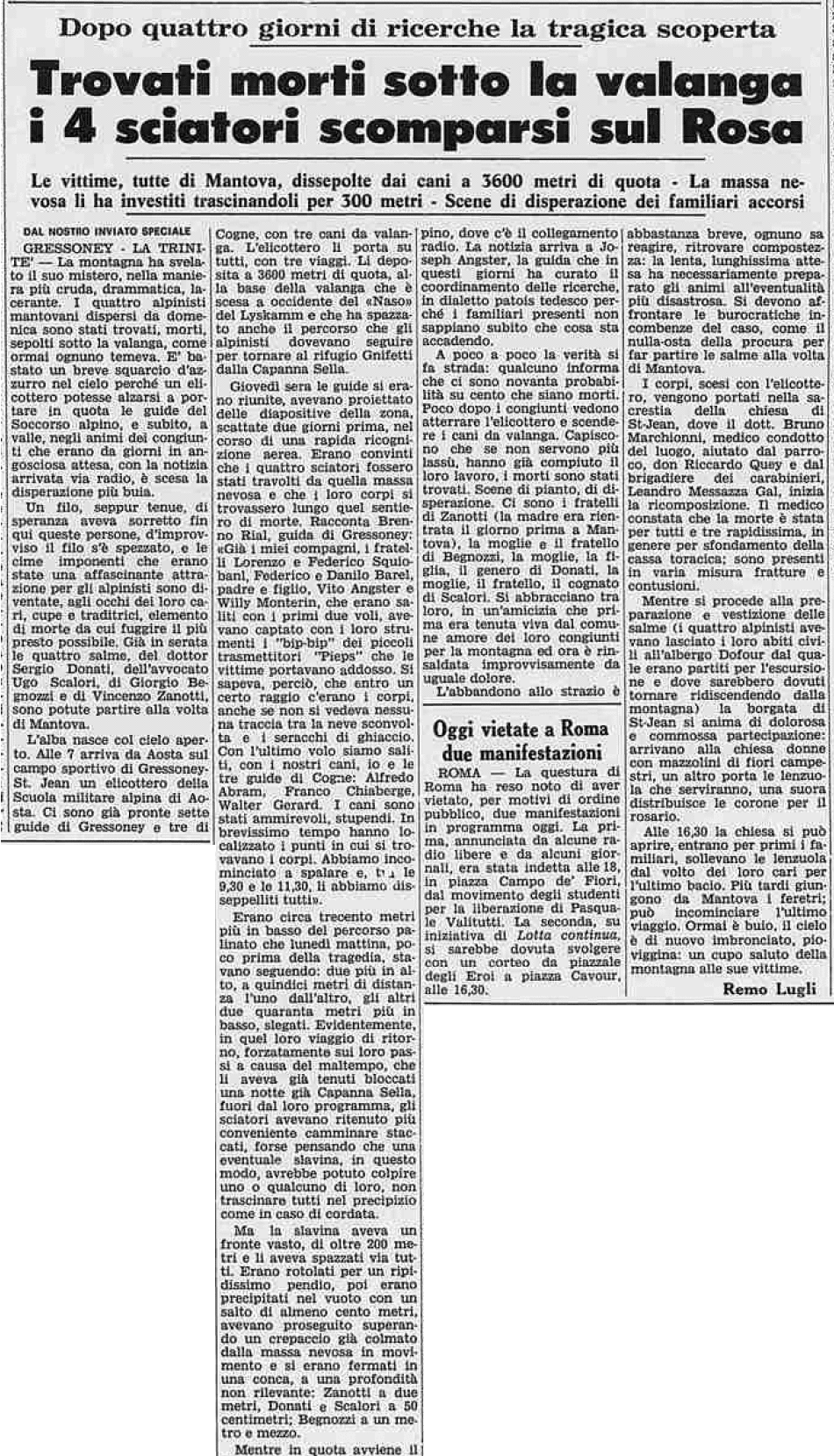
Four skiers found dead under avalanche who went missing on Rosa mountain
Victims, all from Mantua, dug up by dogs at 3600 meters altitude – Snow mass swept over them dragging them 300 meters – Scenes of despair of family members rushed
 (open the article)
FROM OUR SPECIAL CORRESPONDENT
GRESSONEY – LA TRINITE’ – The mountain has revealed its mystery, in the most raw, dramatic, lacerating way. The four Mountaineers from Mantua who had been missing since Sunday were found, dead, buried under the avalanche, as everyone now feared. All it took was a brief glimpse of blue in the sky for a helicopter to lift off to take the mountain rescue guides to higher ground, and immediately, down in the valley, in the spirits of the relatives who had been anxiously waiting for days, with the news coming over the radio, the darkest despair descended. A thread, albeit a tenuous one, of hope had held these people up so far, suddenly the thread snapped, and the imposing peaks that had been a fascinating attraction for the mountaineers became, in the eyes of their loved ones, gloomy and treacherous, an element of death from which to flee as soon as possible. Already in the evening the four bodies, of Dr. Sergio Donati, lawyer Ugo Scalori, Giorgio Begnozzi and Vincenzo Zanotti, were able to leave for Mantua. Dawn is born with the open sky. At 7 a.m. a helicopter from the Aosta Military Alpine School arrives from Aosta on the sports field of Gressoney St. Jean. There are already seven guides from Gressoney and three from Cogne ready, with three avalanche dogs. The helicopter takes them all on three trips. The frantic rescue operation, which it was hoped would enable someone to be found alive, began at dawn this morning, after a night of agonizing waiting during which the rescuers and families of the four victims were weighed down by a feeling of helplessness in the face of the tragedy: yesterday and the day before, the weather had remained bad and the teams had been unable to move. By Thursday evening, the guides had gathered, projected slides of the area, taken two days earlier during a quick aerial reconnaissance. They were convinced that the four skiers had been swept away by that mass of snow and that their bodies lay along that path of death. Brenno Rial, a guide from Gressoney, recounts: “My companions, the brothers Lorenzo and Federico Squiobani (actually Arturo and Oreste Squinobal, ed.), Federico and Danilo Barel (actually Barrel, ed.), father and son, Vito Angster and Willy Monterin, who had climbed with the first two flights, had picked up the “beeps” of the small “Pieps” transmitters that the victims were carrying with their instruments. It was known, therefore, that within a certain radius were the bodies, although no trace could be seen among the disrupted snow and ice seracs. With the last flight we went up, with our dogs, myself and the three guides from Cogne: Alfredo Abram, Franco Chiaberge, Walter Gerard. The dogs were admirable, wonderful. In a very short time, they located the spots where the bodies were. We started shoveling, and between 9:30 and 11:30, we dug them all up.” They were about three hundred meters below the staked path they were following on Monday morning, shortly before the tragedy: two higher up, fifteen meters apart, the other two forty meters below, untied. Evidently, on their return journey, forced to retrace their steps due to bad weather, which had already kept them stranded overnight at Capanna Sella, outside their schedule, the skiers had decided it was safer to walk separately, perhaps thinking that, in this way, an avalanche could hit one or some of them, rather than dragging them all into the precipice as would have been the case if they had been roped together. But the avalanche had a vast front of more than 200 meters and had swept them all away. They had rolled down a very steep slope, then plummeted at least a hundred meters into the void, continued past a crevasse already filled by the moving snow mass, and stopped in a hollow, at an unremarkable depth-Zanotti at two meters. Donati and Scalori at 50 centimeters; Begnozzi at 1.5 meters. While the recovery takes place at altitude, four mountain rescue financiers from Cervinia and a carabiniere from Courmayeur also ascend by helicopter to lend a hand. Down below, the relatives are all gathered in the Sport bar in St-Jean, headquarters of the Alpine Rescue Service, where there is a radio link. The news comes to Joseph Angster, the guide who has been coordinating the search these days, in German patois dialect so that the family members present do not immediately know what is happening. Gradually the truth dawns: someone informs that there is a ninety out of a hundred chance that they are dead. Shortly afterwards, the relatives saw the helicopter land and avalanche dogs descend. They understand that if they are no longer needed up there, they have already done their job-the dead have been found. Scenes of weeping, of despair. There are Zanotti’s brothers (his mother had returned the day before to Mantua), Begnozzi’s wife and brother, Donati’s wife, daughter, son-in-law, and Scalori’s wife, brother, and brother-in-law. They embrace each other, in a friendship that was previously kept alive by their relatives’ shared love of the mountains and is now suddenly strengthened by equal grief. The abandonment to the heartbreak is quite brief, everyone knows how to react, regain composure: the slow, very long wait has necessarily prepared spirits for the most disastrous eventuality. The bureaucratic tasks involved, such as the clearance from the prosecutor’s office for the bodies to leave for Mantua, must be addressed. The bodies, brought down by helicopter, are taken to the sacristy of the St-Jean church, where Dr. Bruno Marchionni, local medical officer, aided by the parish priest, Fr. Riccardo Quey, and Carabinieri Brigadier Leandro Messazza Gal, begin the reassembly. The doctor notes that death was very rapid for all three, usually from rib cage breakthrough; fractures and bruises are present to varying degrees. While the bodies were being prepared and dressed (the four mountaineers had left their civilian clothes at the Dofour Hotel from which they had left for the hike and where they were to return on their way down the mountain), the hamlet of St-Jean came alive with sorrowful and emotional participation: women arrived at the church with bouquets of country flowers, another brought the sheets they would need, and a nun distributed rosary wreaths. At 4:30 p.m. the church can be opened, family members enter first, lifting the sheets from their loved ones’ faces for the last kiss. Later, coffins arrive from Mantua; the final journey can begin. By now it is dark, the sky is sullen again, drizzling: a somber salute of the mountain to its victims.
Remo Lugli
(La Stampa, May 27, 1978)
The opening of the shelter in 1984
Three articles, from September 2 (official opening day) to September 4, 1984
The inauguration of the Mantova refuge (3,457 meters)
A party on Monte Rosa
 (open the article)
GRESSONEY — Today marks the official inauguration of the Città di Mantova mountain hut on the Garstelet glacier in the Monte Rosa massif, at an altitude of 3,457 meters. To mark the occasion, the Gressoney mountain guides, who own the building, have organized a series of events on the wide esplanade that stands near the hut. The families of the four mountaineers from Mantua who died in May 1978 during a mountaineering excursion on Mount Rosa and to whom the new hut was dedicated will be present. It was precisely to reward the search efforts of the Gresson guides, who were engaged for over a week in recovering the bodies of the unfortunate mountaineers, that the relatives of the four young victims (Giorgio Pagnozzi, Sergio Donati, Vincenzo Zanotti, Ugo Scalari) as a sign of gratitude, put 20 million at the disposal of the rescuers, to begin 1 construction work on the refuge. The Region of Valle d’Aosta, the Italian Alpine Club, and the municipalities of Gressoney-St-Jean, La Trinité, and Mantua also contributed to the completion of the project, which cost €400 million. The “Mantua Refuge,” which is run by two young men from Pont-St-Martin who are mountain enthusiasts, Sandro Juglalr and Roberto Ganis, has already been opened to the public in early July and offers about 80 beds plus restaurant services. Today at 8 a.m., a helicopter will be available at the Stafal square to take people up to the refuge, while those who wish to walk up should meet at 6.30 a.m. at Gabiet. The Gressoney guides will have among their guests, in addition to regional and municipal administrators, Agriculture Minister Pandolfi and probably Ministers La Malfa and Reviglio. Bishop Ovidio Lari of Aosta will celebrate Mass while the Pont-St-Martln marching band will cheer 11 afternoon.
w. b.
(La Stampa, September 2, 1984)
Named after the City of Mantua
NEW SHELTER OPENED ON PINK
ALAGNA VALSESIA — (r. q.) Since yesterday, Monte Rosa has a new refuge: the Città di Mantova. It was inaugurated in the presence of a large crowd of mountaineers, including the presidents of Cai Priotto and Germagnolt Guides. Also present were Mr. Rognoni and Mr. La Malfa, who are not at their first experience on Rosa as they already spoke at the inauguration of the Margherita Hut, the highest in Europe. The bishop of Aosta, Monsignor Lari, blessed the refuge built in memory of four mountaineers from Mantua who were swept away by an avalanche on the Naso del Lyskamm six years ago in May. Città di Mantova is located at an altitude of 3,498 meters among the rocks that border the Garstelet glacier, not far from the Gnifetti hut. It was constructed over six years of work with financial contributions from the Aosta Valley Region, the Mantua section of the CAI, its members and the families of the four mountaineers who perished. Gressoney mountain guides contributed specialized contractors to the construction of this new facility, which has about sixty beds, a restaurant room, and a panoramic balcony that projects toward the glacier. The point at which this refuge has been “anchored” (it has been tested to withstand wind speeds of over 200 km per hour) is a mandatory passage for those tackling the southern slope of Monte Rosa. In fact, just further down the valley, the Valle d’Aosta route from Gressoney-Lago Gabiet and the Valsesian route from Alagna-Punta Indren join a single trail on the Garstelet glacier. With ti new hut, the number of beds allocated to mountaineers on Mount Rosa rises to between 330 and 340: availability at the Gnifettl Hut exceeds 200 and at the Margherita is about 70.
(La Stampa, September 3, 1984)
The “Città di Mantova” was inaugurated on Sunday
Glacier hut
 (open the article)
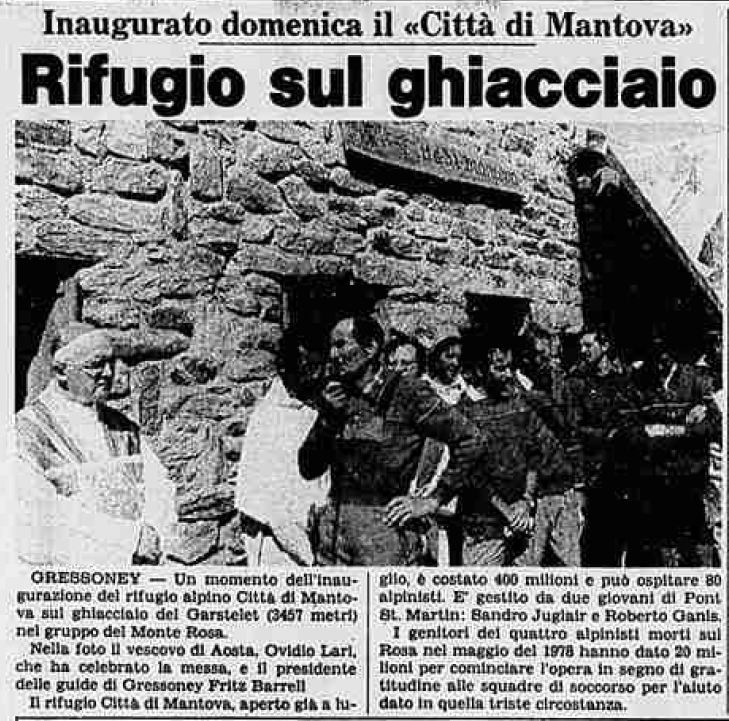
GRESSONEY — A moment from the inauguration of the Città di Mantova mountain hut on the Garstelet glacier (3,457 meters) in the Monte Rosa massif. Pictured are the bishop of Aosta, Ovid Lari, who celebrated the Mass, and Gressoney Guides President Fritz Barrell. The Città di Mantova refuge, which opened in July, cost 400 million and can accommodate 80 mountaineers. It is run by two young people from Pont St. Martin: Sandro Juglair and Roberto Oanis. The parents of the four mountaineers who died on Rosa in May 1978 gave 20 million to begin the work as a token of gratitude to the rescue teams for their help on that sad occasion.
(La Stampa, September 4, 1984)

